
The state of Minnesota is actively working to eliminate Mycoplasma hyopneumoniae (M. hyo), a persistent respiratory pathogen that continues to cause significant health and economic challenges across the pork industry. While many breeding herds have completed elimination programs over the past one to three years, their ongoing status often remains unconfirmed due to a lack of routine diagnostic monitoring.
“M. hyo colonizes the cilia of the lower respiratory tract, meaning sensitive diagnostic testing requires lower-tract samples like deep tracheal secretions,” explains Kaydance Hinn, a second-year student at the University of Minnesota College of Veterinary Medicine. “Collecting those samples from live sows is labor-intensive, physically demanding and stressful for both the pig and the barn crew.”
Capitalizing on a Missed Opportunity
As an assistant researcher for both the Mycoplasma Research Lab at the University of Minnesota and the Swine Disease Eradication Center, Hinn set out to find a practical alternative: utilizing routine sow mortalities prior to rendering or disposal.
Because mortalities already provide direct access to the lower respiratory tract, barn staff can collect diagnostic-quality samples without restraining a live animal.
“Not only is this technique fast and easy, but it allows producers to passively monitor herd health for M. hyo using their daily mortality,” says Hinn. “The entire procedure can be done by a single worker in under two minutes.”
Putting the Technique to the Test
In a field study evaluating the method, Hinn will be enrolling 10 sow farms that recently completed M. hyo elimination programs. Participating farms will collect deep tracheal swabs from all mortalities older than six months—including sows, gilts and boars—for nine months (or up to 250 samples per farm).
The dry swabs will be stored in on-farm freezers at -20°C and shipped monthly on ice to the Minnesota Veterinary Diagnostic Laboratory (VDL) for species-specific real-time PCR testing.
To ensure consistency across farms for the study, Hinn created a step-by-step training video featuring voiceovers in both English and Spanish to eliminate language barriers in the barn. While created for the project, the video is publicly accessible for any producer or veterinarian looking to enhance herd surveillance.
“With national efforts like the U.S. SHIP monitored herd certification program moving forward, having practical surveillance tools is critical,” Hinn notes. “Every piece of the M. hyo puzzle helps us take one step closer to complete disease eradication.”
The 2-Minute Mortality Swab Protocol
Target:
Any mortality > 6 months of age (sows, gilts, boars).
Supplies:
Sharp necropsy knife, disinfectant wipes, sterile swabs, resealable labeled bags, marker, PPE.
Steps:
- Make a deep incision on the caudal neck (just in front of the shoulders).
- Palpate the larynx (a hard, tennis-ball-sized structure) and locate the cartilage rings of the trachea just below it.
- Make a partial incision into the tracheal rings (avoid cutting completely through to keep grip).
- Insert a sterile swab as deep into the trachea as possible, rotating to saturate it thoroughly with tracheal secretions (avoiding external skin/blood contamination).
- Store the dry swab at -20°C in the farm’s freezer.
- Ship frozen batches monthly under cold chain to the University of Minnesota VDL for species-specific real-time PCR testing.
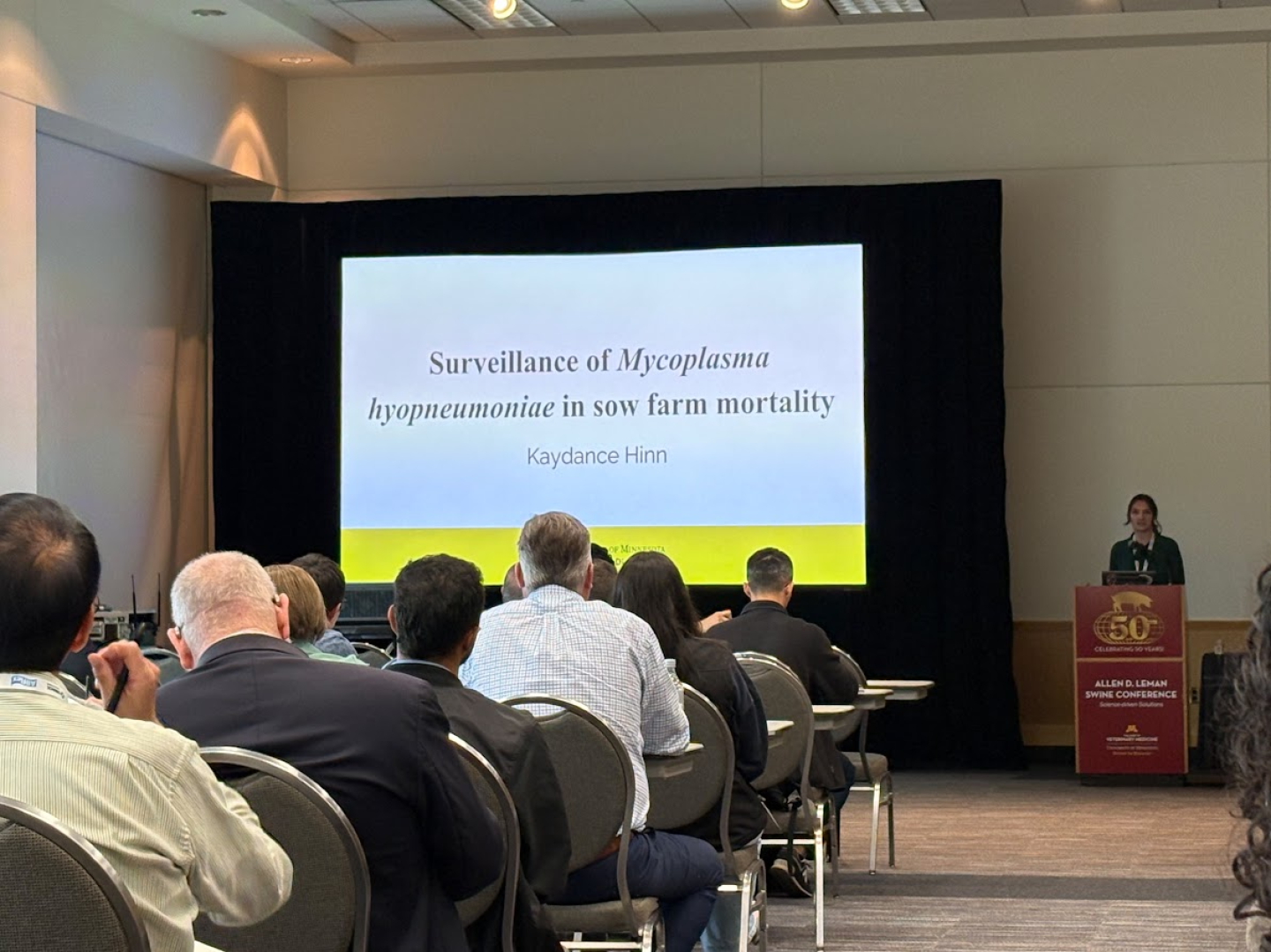
For her work on this project, Hinn was selected as one of seven finalists for the Morrison Swine Innovator Prize at the Allen D. Leman Swine Conference, where she presented these findings to industry leaders and veterinarians.
This article was written by Jennifer Shike and originally published in Farm Journal’s PORK.
