The 2018 Allen D. Leman Swine Conference successfully continued its tradition of high-quality content while innovating

The 2018 edition of the Allen D. Leman swine conference held in St. Paul, MN continued to offer a wide range of high-quality, science-driven presentations while innovating on several aspects of its program.

JSP-7273
Megan Bloemer (right) receives the Morrison Swine Innovator Prize from Dr. Perle Boyer (left)

This year marked the second year of the DVM student session at the Leman conference but the first time that a student received the Morrison Swine Innovator Prize. Megan Bloemer, a student from the University of Illinois was truly honored to be the first recipient of this prestigious recognition. Megan received a $7,500 scholarship in addition to participating in an exclusive workshop with the other DVM students-presenters. The quality of the students’ presentations was excellent but the practicality and the innovation with which Megan treated the issue of truck wash biosecurity put her at the top.

Sunday afternoon, the new Beer and Bacon conversation series was launched. The session, during which Dr. Matthew Turner was interviewed by Dr. Marie Culhane, was extremely popular. Seating was limited so do not forget to register early if you would like to attend next year!

JSP-7274
Dr Rebecca Robbins (left), Science in Practice awardee and Dr. Montse Torremorell (right)

We celebrated Dr. Rebecca Robbins for her well-deserved recognition as the Science  in Practice awardee of the year. The reception held in the Science museum in St Paul was sponsored by Boehringer Ingelheim.


The spread of African Swine Fever in China and Western Europe prompted us to dedicate two very well-attended sessions on this topic. The first session on Monday afternoon coordinated by Dr. John Deen included a summary of what is known about the disease by Dr. Chris Oura, then a clinical case experienced in Russia by Dr. Gustavo Lopez and a presentation by Patrick Webb on ASF awareness in the industry and beyond. On Tuesday, Dr. Scott Dee presented his latest research on the risk from feed ingredients for the transmission of ASF.

For more information, the University of Minnesota launched two webpages:

The 2018 Allen D. Leman conference continued to propose high quality keynote speakers.
Dr. Brad Freking and Dr. Deb Murray from New Fashion Pork gave the first Morrison lecture and presented their vision of pig farming. They explained how they chose to decrease their antimicrobial usage while reserving the right to treat pigs when needed and why they launched Old Fashion Pork.

JSP-7211
Dr. Maria Pieters presenting

Dr. Maria Pieters reminded us of the issues associated with having a Mycoplasma hyopneumoniae  positive herd and challenged the swine industry to eradicate the diseases that can be eradicated so that we can focus on diseases that are harder to control.

Becca Martin and Randy Spronk gave an update on trade in pigs and the current challenges that we are facing as an exporting nation. Free trade seems to be the best option for our producers in order to maintain the market.

Dr. Michael Rahe presented the Pijoan lecture on behalf of Dr. Michael Murtaugh giving us a overview of the past 30 years dealing with PRRS. Sadly, Dr. Murtaugh passed away that very same day, from his battle with cancer.

As always, we would like to thank all of you for your continuing support. The Allen D. Leman swine conference would not exist without you and we hope to see you next year: September 14-17, 2019.

This slideshow requires JavaScript.


Science Page: African swine fever experience in a large commercial system in the Russian Federation

This is our Friday rubric: every week a new Science Page from the Bob Morrison’s Swine Health Monitoring Project. The previous editions of the science page are available on our website.

This week, we are sharing the experience Dr. Gustavo Lopez, a PhD candidate at the University of Minnesota, had dealing with African Swine Fever in Russia.

Key points:

  • Infected pigs can be asymptomatic carriers of African swine fever virus (ASFv)
  • Timely detection with diagnostic testing, strict biosecurity measures and rapid removal of the source of infection are key to limit the transmission of the virus within and between sites.

In December 2014, ASFv was detected in a finishing site of a multiplier herd from a large commercial pig company located in the Russian Federation. The region had multiple reports of ASFv in backyard pigs before the outbreak. The affected company consisted of 80,000 sows in 15 farms organized as a three-site production system with each sow farm having a dedicated nursery and two finishers. The multiplier herd supplied gilts from the finisher to the gilt development unit (GDUs) for each farm. Each sow farm had a quarantine within the farm to receive the gilts from the GDU .

A 3% mortality increase was reported in one room of the finishing site. A few pens in one of the rooms had pigs affected with fever, purple ear and mild scouring. The site was being monitored for ASFv on a weekly basis before gilt shipment, following local regulations and results always came back negative.

Samples collected from the affected pigs were negative for ASFv, Classical Swine Fever, PRRSv, and Salmonella so the decision was made to resume shipment of gilts from a room with no clinical signs to the GDU.

As the days progressed, the clinical signs in the affected room worsened and affected more pens. The GDU that had just received gilts reported similar clinical signs and diagnostics on samples collected then from the multiplier finisher and the GDU confirmed the presence of ASFv at both sites.

At that time, all pig movements were stopped and a 5km quarantine area was imposed around the two affected sites. Gilts that had been sent from the GDU to five commercial sow farms, and were in quarantine tested negative to ASFv. Nevertheless as a precaution, the decision was taken to sacrifice all the gilts in the quarantines.

Protocols mandated by the government were implemented in the ASFv positive multiplier finisher and GDU which consisted of euthanasia of all pigs within a 5km radius, destruction with burial and burning of all carcasses, strict movement restrictions for vehicles and people and exhaustive disinfection protocols inside the farm and its territory.

Transportation of infected non-symptomatic animals from the multiplier finisher was the most likely route of infection to the GDU. The source of infection to the multiplier finisher is unknown, although people are thought to have played a role given the presence of ASFv in backyard farms in the area. Events such as introduction of infected pork meat, lack of proper disinfection of 3rd party trucks or non-compliance with the shower-in policy of the farm could not be ruled out. The outbreak occurred in December when temperatures were below zero Celsius and wild pig-tick-domestic pig interaction was unlikely.

It is important to point out that 12 of the 16 rooms in the multiplier finisher remained negative to ASFv until the moment of euthanasia. The sow farm and nursery multiplier were monitored for ASFv during the quarantine period and until the moment of euthanasia 6 months later. During this time, they remained negative to ASFv, even though they were within close proximity to the affected farm. Our experience indicates that a timely detection of ASFv with testing, strict biosecurity measures and removal of the source of infection as soon as possible can limit the transmission of the virus between sites.


African Swine Fever information repository web page

The spread of African Swine Fever in China and in Europe has been raising concerns in the US swine industry. To answer the need of updated and relevant information, we created the webpage: z.umn.edu/AfricanSwineFever.

Among other resources you will find recording of the session of the 2018 Allen D. Leman Swine Conference, a link to the Swine Disease Global Surveillance reports, and preparedness checklists from the Pork Checkoff.
question-mark-1495858_1920

The page is organized to answer the following questions:

  • What do we know about African Swine Fever virus?
  • What is the progression of African Swine Fever worldwide?
  • African Swine Fever in the field
  • What are the available diagnostic tests for African Swine Fever?
  • How to prepare for African Swine Fever
  • Is there a vaccine against African Swine Fever?
  • Is feed a concern?

ASF update: Swine Disease Global Surveillance bi-monthly report

This report was published by the Swine Health Information Center and prepared by the University of Minnesota.

Epidemiological Situation

Belgium

On September 14th, the OIE official report of the 1st ASF case in Belgium was released, confirming our previous report. On Saturday, 15th, the Federal Agriculture minister confirmed three new cases in the same area of the initial report, identified in wild boars found dead in the city of Etalle (Luxembourg province), near the border with France.

On Friday evening, a multisectoral meeting took place in Belgium, where the farming, meat and animal feed sectors asked for priority measures against the spread of African Swine Fever to be in place. In the joint statement coming from that meeting, they draw up five possible critical needs/measures to mitigate the disease spreading: a European plan to define and maintain the affected zone; the creation of a committee dedicated to the export of meat and pork products; a regulated slaughtering and butchering method for pigs in the area which is under tight surveillance; a realistic and feasible plan to reduce the boar population in the country; and finally the creation of a crisis communication committee.

Arrangements are being done to ban the movement, hunting and feeding of wild boars in the region to control the spread of the disease by human interaction. An investigation and monitoring program is being implemented, with the support of European experts.

China

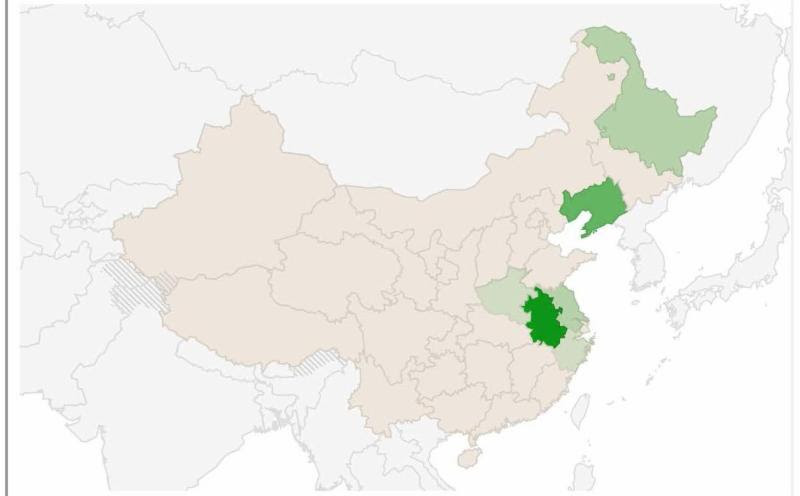
With the reporting of two new outbreaks today (September 14th), unofficially, there have been 21 ASF outbreaks reported in China. The last two reported outbreaks included (a) 16 hogs with sudden death in the Inner Mongolian Province, and (b) a farm in Henan Province, with 148 infected pigs and 43% fatality rate. Officially, however, the OIE WAHIS platform still reports only 19 outbreaks in six provinces (Figures 1 and 2). Although the cause of ASF introduction into China remains unclear, in March, 2018, FAO alerted for the risk of introduction of ASF into the country by illegal introduction of animals or food. There are also concerns that, similarly to what has been reported in Europe, wild boars may play a role in the spread of the disease.

Control Activities

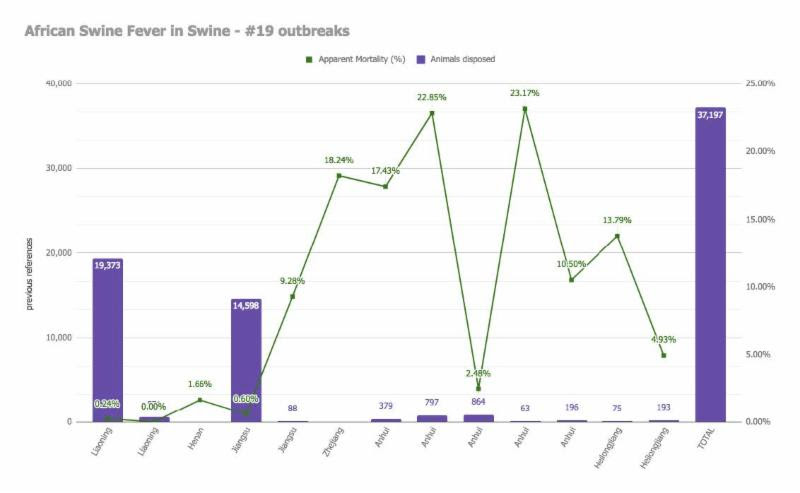
Approximately 40,500 pigs have been culled since the beginning of the epidemic, with mortality rates that varied between 0 and 23.17% (Figure 1). The Chinese government reported checking pigs in thousands of sites, which may have resulted in the increase of the identification of new outbreaks. In an attempt to contain the spread of the disease, all transport of live animals from infected provinces is restricted, feed policy is being adjusted to the current scenario, and the logistics of the industry and the Chinese market are being reviewed. On September 13th, the use of food waste and pig blood as feed for pigs in ASF-infected and neighboring provinces was banned. Also, testing pig feed to ASF will be required, and positive samples will trigger destruction of the whole batch of feed.

Disease Impact

China is considering to import meat from other markets, including the European Union, that in 2017 faced an intense decline in pork exports. US hog market is also currently facing a low price market, however with expansion in number of sows and pork produced. International trade is at risk once ASF is spreading rapidly into consolidated markets like Europe and China, and concerns are growing around the globe.


Figure 1: Summary of outbreaks of African Swine Fever in China. Nineteen outbreaks were reported to OIE, in 6 provinces: Lianoning, Henan, Jiangsu, Zhejiang, Anhui, Heilongjiang (Source: OIE – WAHIS).


Figure 2: Chinese provinces with reported ASF outbreaks (Lianoning, Henan, Jiangsu, Zhejiang, Anhui, Heilongjiang). The intensity of the green shade depicts the number of culled animals, with the Province of Liaoning (darkest green) showing the highest cull rate.


African Swine Fever: 2 podcasts available

We are coming back with 2 new podcasts on African Swine Fever today.

First podcast on African Swine Fever

In this first of a two part episode of At The Meeting Honoring Dr. Bob Morrison, we share a conversation on African Swine Fever or ASF.

Dr. Montse Torremorell joins Dr. Tom Wetzel and Dr. Gordon Spronk with special guest Dr. Liz Wagstrom, Chief Veterinarian for the National Pork Producers Council, to talk about ASF and how it is the most feared disease in pigs in the world.

Take away:

  1. Having ASF in the United States would impact trade
  2. ASF is a hardy virus (hard to eradicate and lives in extreme conditions), and
  3. there is no vaccine.

The U.S. pork industry is taking action now by making sure laboratory capacity is up to date, looking at identifying and categorizing higher risk transmission paths plus their mitigation plans, and improving the approach to surveillance and risk planning and implementation.

Second podcast on African Swine Fever

In this second of a two part episode of At The Meeting Honoring Dr. Bob Morrison, we continue our conversation on African Swine Fever or ASF. Dr. Montse Torremorell joins Dr. Tom Wetzel and Dr. Gordon Spronk with special guest Brad Heron, Director of Operations of Cherkizovo (pronounced “Chair-Kee-Zi-Vo”) in Russia. Brad offers a personal, boots on the ground perspective on ASF.

Brad shares several stories of how ASF was discovered and handled on the Russian farms he helps run. The early disease indicators were confusing due to other animal diseases also running its course so ASF was not discovered as early as they had thought they would.

Brad highlights what happened to the operations when ASF was discovered, actions they had to take, and the Russian regulations they had to work with requiring depopulations within a five mile radius. He also summarizes the biosecurity changes they made to defend against ASF, including transportation tracking, multiple testing points through out the operations, and physical farm and people security improvements.

The number one key take away from Brad: Have good testing; if you don’t test, you don’t have the ability discover outbreaks.

Remember that this afternoon a special session will be held at the Leman Conference regarding African Swine Fever.