Classical Swine fever reported in Japan 26 years after last outbreak
On Sunday September 9th, Japan reported the occurrence of Classical Swine fever, in a farm located at Gifu Prefecture, in the central area of the country. Last week, one pig died suddenly, followed by the mortality of 80 others. On Sunday, officials declared the animals as tested positive for Classical Swine fever (CSF), also known as Hog Cholera. Currently, China is facing an epidemic of African Swine Fever, which is totally unrelated to this event in Japan. To date, Japanese Veterinary Services have ruled out the occurrence of African Swine Fever (ASF) in this outbreak or in the country.
A task force was implemented, and the remaining 610 pigs were culled to contain the outbreak. By Monday morning (local time) depopulation of the farm was completed. At first, no clear origin of infection was identified as feed was commercial, nor there were known foreign labors or visits from countries endemic with CSF working in the farm. At this point, cause of the virus introduction is unknown and under investigation.
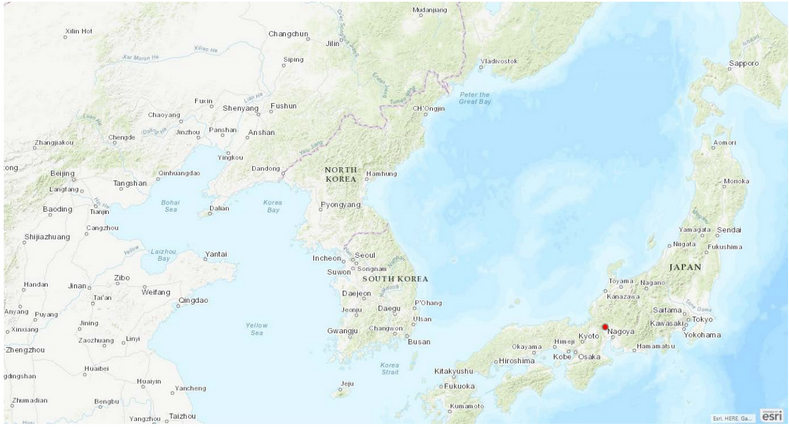
Exports of pork have been suspended until the Veterinary Services are capable of understand the extension of the outbreak and if the measures were sufficient to contain it, while investigations about possible routes of introduction are implemented as well. The Gifu Prefecture is not the major area of swine production, and it is located 500 miles (800 kilometers) from the south region, the highest pig-dense area.
Figure 1: Map of Japan, and Prefectures. In red, location of the Gifu Prefecture, in Central Japan. The highest pig-dense area of Japan is located in the south region of the country (adapted from Sasaki et al.,2017) approximately 500 miles (800 km) from Gifu Prefecture by road.
CSF is a notifiable disease and affects the international trade of pork, however, clinically it is usually considered less severe than ASF. Currently, it is considered endemic in many countries, including China, therefore it is a disease with potential direct and indirect effects to the US industry. Depending on the strain, extensions of outbreak, route of introduction and effectiveness of biosecurity measures to contain and prevent re-introductions, it could offer different levels of risk. Commercial vaccines are available for CSF control.
The last CSF outbreak in Japan was in 1992 in Kumamoto Prefecture, and in 2007 the use of vaccination was banned, and disease eradication was declared in the country. The Japanese swine industry is still recovering from the 2013-2016 PED epidemic. On July 9th-2018, APHIS published the official notice of the OIE recognition of Japan as free CSF. Currently Japan exports pork, and it is in the top-10 pork producing countries in the world. FAS/Tokyo estimates Japanese swine slaughter held stable at 16.336 million head in 2017.
At this point, no other cases of CSF are suspected in Japan.
Figure 2: Report of classical Swine Fever in Japan. In red, Gifu Prefecture in Japan, located in the central area of the country. Score 2.*
*SDGS – Significance score: A scoring system to assess the likelihood a disease event will impact the global swine industry. Scores range from 1-3 (low-high) based on the novelty of the disease, effect on the swine industry, and impact on trade.
This is our Friday rubric: every week a new Science Page from the Bob Morrison’s Swine Health Monitoring Project. The previous editions of the science page are available on our website.
New introductions of ASF to free areas of the disease are usually by uncooked pork fed to pigs.
Virus can be inactivated with temperature and low pH.
Survivor animals may play a role in the transmission and persistence of the disease.
Further outbreaks of African Swine Fever virus (ASFV) were reported last week in China several miles away from what is thought to be the first outbreak. This geographic dispersal leads us to think about dissemination mechanisms within the country and between countries.
EPIDEMIOLOGY
Infected animals will go through a viremic phase and can shed the virus through nasal secretions, feces and urine. Therefore, the main transmission route is oral-nasal, as pigs can be exposed to ASF positive secretions or tissues (i.e. pork products). Indirect transmission can also occur by exposure to contaminated fomites. This virus can also be transmitted by ticks. This vector-borne route becomes relevant when the wild boar
population is present and moves across regions and countries. The common introduction route into ASF free regions is usually through positive pigs transported into the area, or contaminated pork products that are fed to other pigs. ASFV has also been detected in air samples; however, airborne transmission is considered a secondary route of transmission due to the high virus load needed.
VIRUS SURVIVABILITY
Inactivation and persistence
Although ASFV is highly resistant, the virus can be inactivated at pH < 4 and pH >11. Survivability outside the host is heavily related to temperature. For instance, the infectious half-life in urine and feces can range from 3 to 15 days and 4 to 8 days at 37°C and 4°C, respectively. The virus may persist for several weeks or months in frozen, fresh, or uncooked pork, as well as in salted dried pork products. In contrast, ASFV is inactivated at high temperatures (i.e. 70°C cooked or canned hams) and in cured or processed products such as Spanish cured pork products after day 122–140 of curing. Pigs can become persistently infected and the virus can stay viable in their carcasses for up to six months. Therefore, infected carcasses represent a risk to other pigs. More recently, an investigation simulating a trans-Atlantic shipping of ASFV contaminated feed ingredients from Europe proved that viable virus can be recovered after 30 days.
The role of survivor pigs
ASFV recovered and sub-clinically infected pigs become a source of virus to other pigs. This plays an important role in disease transmission and persistence in endemic areas as well as becoming one of the most important routes of transmission into disease-free zones. In-vivo experiments have revealed an infectious period of moderately virulent virus isolates ranging from 20 to 40 days. In another in-vivo transmission study, pigs that had been exposed to ASFV 90 days prior were commingled with naive pigs and the virus was transmitted to naive pigs.
Serological field studies performed in positive regions of Brazil, the Iberian Peninsula, East Africa, Kenya and Uganda revealed that the there was a very low percentage of seropositive animals one year after the outbreak. It was hypothesized that those few seropositive pigs were still carriers and could have been responsible of some of the newer outbreaks.
CONCLUSION
ASF has a complex epidemiology with different routes of transmission that can involve animals and ticks as direct transmission, and contaminated clothes, tools, and surfaces as indirect transmission. Thus, early detection and intervention of the diseases are key to containing disease spread in absence of an effective vaccine.
Given the recent developments of African Swine Fever (ASF) in China, the Leman Conference is planning a special breakout session on Tuesday morning. The session will cover key aspects of the ASF virus as well as the spread of ASFV in Eastern Europe and China, important elements of ASFV transmission, and implications of the recent developments in China.
Not registered? No problem!
There is still time to register and join your colleagues at the annual educational event for the global swine industry.
African Swine Fever: an update as of September 3rd
The map below summarizes the location of the various Chinese cases compared to each other.
Figure 1: Distances by road from different points: 1: = 870 miles (1,400 km); 2= 1,400 miles (2,253 km); 3: 350 miles (563 km); 4: 800 miles (1,288 km); 5: 500 miles (800km); 6: 317 miles (510 km). Red circle shows the location of cases 2, 3, 4, and 5 in a radius of 347 miles (550 km).